People often ask why a survivor does not "just pack up and leave." The answer almost always comes down to money, custody, and the weaponization of our legal systems.
When we look at the material side of the Duluth Model's Power and Control Wheel, abuse stops looking like interpersonal friction. It looks like a siege. Understanding the signs of economic abuse and the reality of post-separation abuse proves that ending a relationship does not automatically end the danger. In fact, when physical access is gone, abusers routinely shift to financial, legal, and parental leverage.
Here is how those systems are used to maintain power.
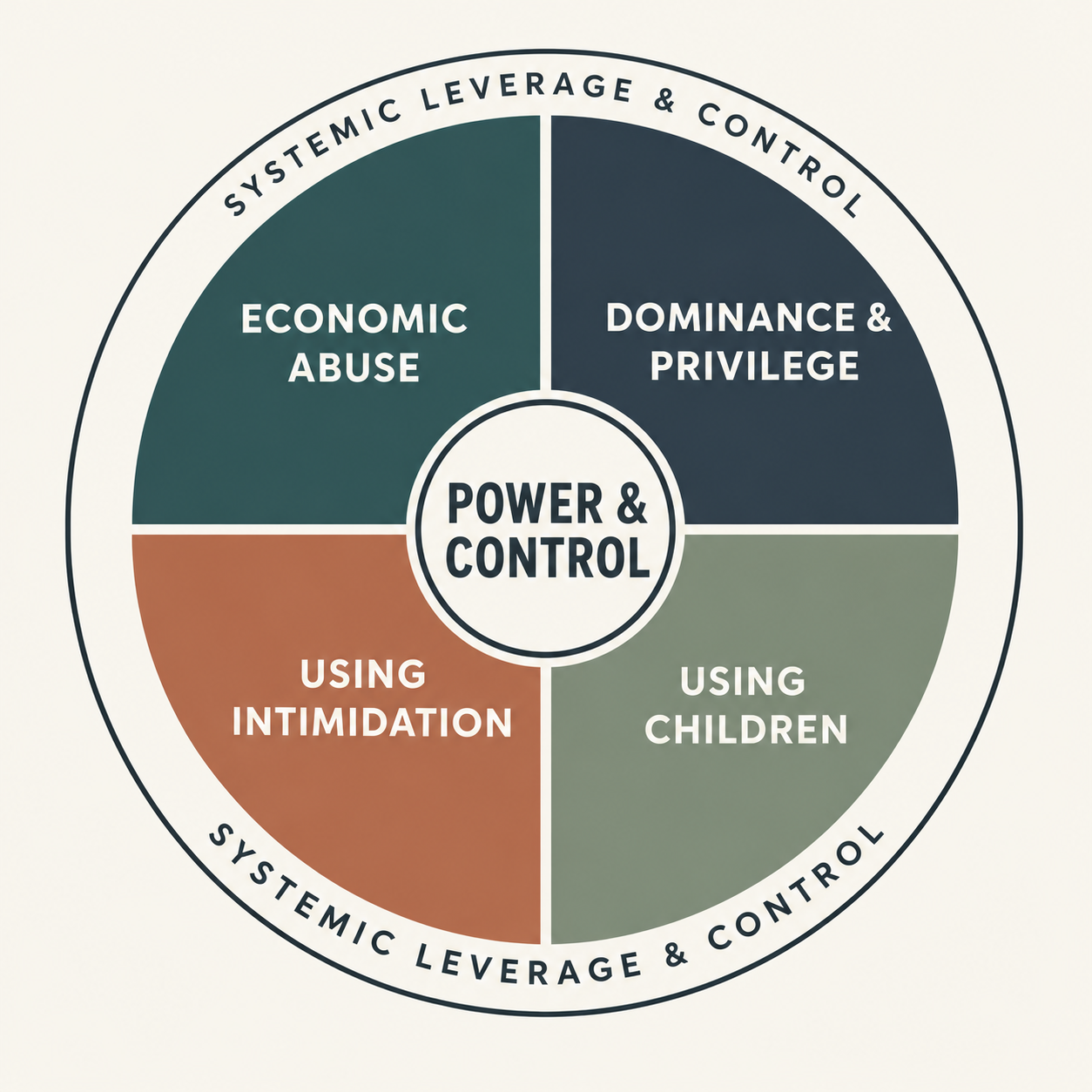
1. The Real Signs of Economic Abuse
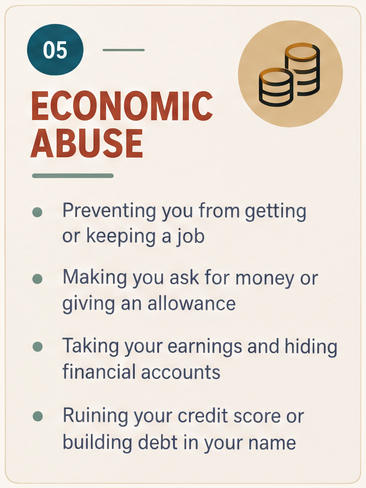
Financial dependence is one of the most effective cages in existence. Economic abuse occurs when one partner controls the other person's ability to acquire, use, and maintain financial resources.
Common signs of economic abuse include:
- Controlling all bank accounts and withholding passwords.
- Granting an "allowance" and demanding receipts for groceries or gas.
- Sabotaging your job: ruining transportation on purpose, hiding work clothes, or calling repeatedly during shifts until you get written up.
- Ruining credit: opening debt in your name without permission or refusing to pay joint bills to tank your credit score.
When you do not have money for a security deposit, first month's rent, or groceries, leaving safely is an uphill battle.
2. Using Children and Post-Separation Abuse
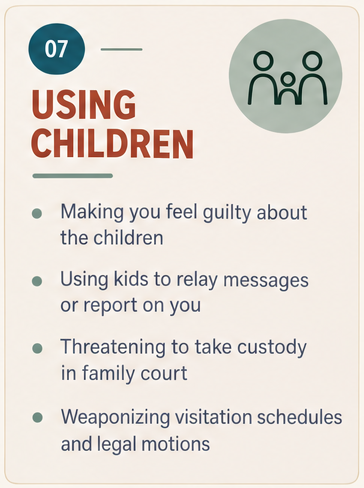
One of the most dangerous myths is that leaving ends the abuse. In reality, post-separation abuse begins the moment the survivor walks out the door. The children frequently become the new delivery mechanism for control:
- Using custody exchanges to harass, monitor, or interrogate.
- Withholding court-ordered child support as retaliation for boundary setting.
- Making false reports to child protective services to maintain intimidation.
- Bad-mouthing the protective parent to the kids to erode the family bond.
3. Dominance and Privilege
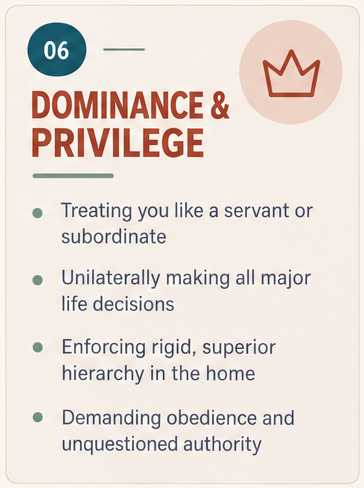
This spoke addresses entitlement: treating one person as the absolute head of the household who makes all final decisions without input and expects total obedience. The wheel names it "male privilege" because it most often shows up through male gender roles, like "I pay the bills, so I make the rules." But the flip side is real too. Women abuse men, and they can weaponize expectations about who is supposed to provide, who gets believed, and who is "allowed" to be a victim. When mutual respect is replaced by hierarchy, equality cannot survive.
4. Intimidation: The Unspoken Warning
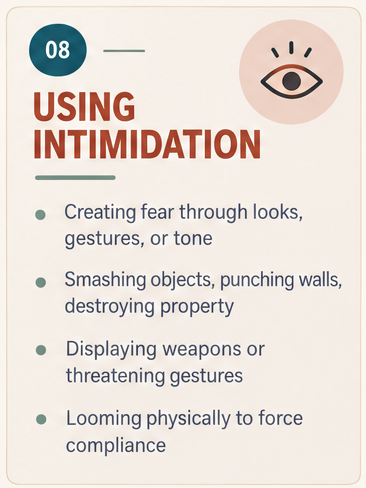
Intimidation does not have to leave a bruise. It looks like smashing things, slamming doors, displaying weapons, blocking doorways during conversations, or giving a specific look in public that means, "Wait until we get home." It creates an environment where walking on eggshells is your baseline.
Building Support Systems That Protect Survivors
Understanding post-separation abuse and financial traps helps us build workplaces, courts, and community programs that do not accidentally collude with abusers.
Check Your Preparedness: Run your organization through our free DVAM Readiness Quiz /dvam to ensure your team is equipped to support survivors navigating these complex barriers.